How to Organise an Education Fair: A Practical Guide for Organizers
By mapmyfair team · · 5 min read
Three weeks before the fair, the organizer's phone tells the story. Forty institutions said "yes, book us" on WhatsApp. Twenty-two have paid, or say they have. Somebody in the office is matching UPI screenshots against a spreadsheet that four people have edited, and two universities both believe they were promised the corner stall by the entrance. Nobody is wrong, exactly. The information just lives in too many places.
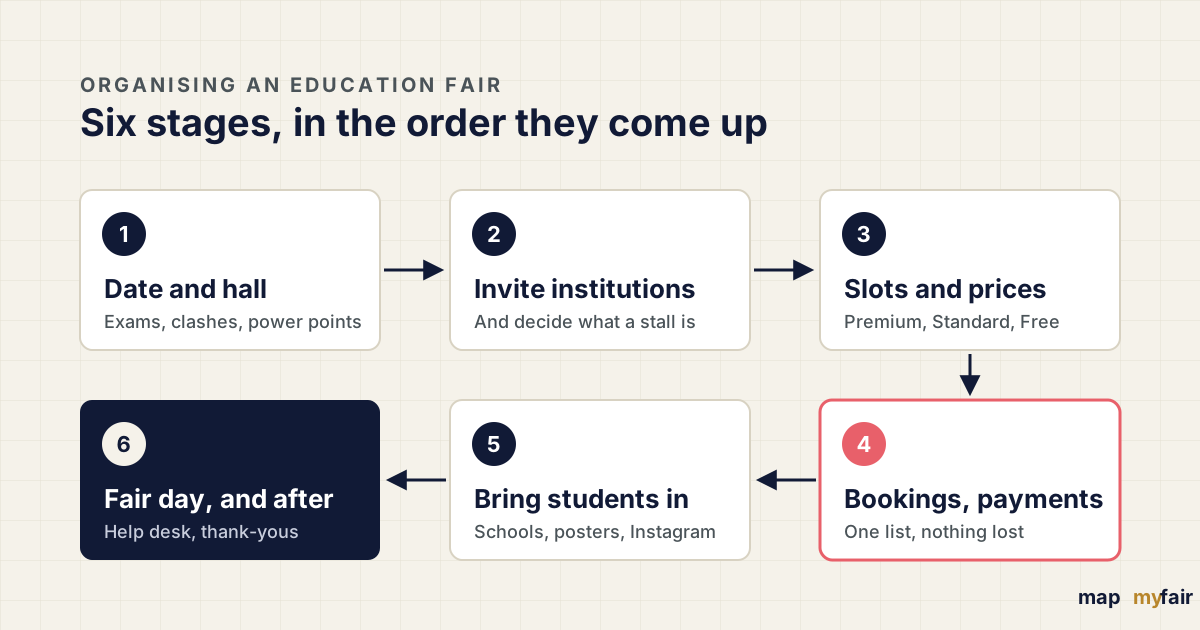
Running an education fair isn't hard because of any one task. It's hard because a hundred small things have to line up on the same two days. This guide walks through them in the order they actually come up, from picking a date to the week after the fair, with the traps that catch first-time organizers and plenty of experienced ones.
Pick the date before anything else
Your date decides who turns up. Students preparing for board exams aren't walking around a hall in February or March, and their parents certainly aren't. The weeks around results and admissions are a different story: families are actively comparing options and will travel across town for a good fair. Study abroad fairs follow their own rhythm, built around the intakes the foreign universities are recruiting for.
Check two more things before you commit. First, what else is happening in your city that weekend: another fair, a big exam, a festival. Second, whether the institutions you want are free. A university's admissions team might do six fairs in a season, and if your date clashes with a bigger one, you'll hear "next time" a lot.
Choose a hall that works for stalls, not weddings
Banquet halls are built for round tables and a stage. A fair needs something else: a clear floor you can divide into stalls, power points you can actually reach from those stalls, and a way in that doesn't send every student through a narrow side door. Walk the hall with a tape measure. Count the plug points. Ask what the venue provides (tables, chairs, backdrops, Wi-Fi) and what you'll be paying a vendor for on top.
Ground floor, near public transport, with parking for the exhibitors' cars. Honestly, those three matter more than how grand the lobby looks.
Decide who you're inviting, and what a stall is
Most education fairs mix universities and colleges with schools, study abroad representatives, coaching institutes and the occasional education-loan desk from a bank. Decide early which of these you want. A fair for Class 11 and 12 students looks very different from one aimed at graduates thinking about a master's abroad.
Then write down what one stall means: its size, a table, two chairs, a power point, a name board. Put it in writing before you quote a single price. Half the arguments on fair day start with "we thought the stall came with…".
Set your categories and prices
Not every stall is worth the same. The ones by the entrance, the corners, the front row facing the seminar area: institutions will pay more for those, and they should. Most organizers end up with two or three categories, say Premium and Standard, plus a few free stalls kept for partners. We've written a separate piece on how to price and sell stalls, with the maths worked out.
Make booking and payment boring
This is where most of the stress comes from, and it's almost all avoidable.
When bookings come in over calls, emails and WhatsApp, every one of them needs someone to remember it. Which stall did we give them? Did they pay the full amount or the advance? Did we send the agreement? Was the invoice in the right name, with the right GST number? Multiply that by fifty institutions and you have a full-time job that only exists because the information is scattered.
The fix is one place where:
- institutions can see which stalls are still free and pick one themselves;
- a stall is held for a short while once they've asked for it, so two people can't take the same one;
- they upload their payment proof, and you confirm it in one click;
- the agreement and the invoice go out on their own once the money's in.
That's exactly what we built mapmyfair to do, but even if you stay with a spreadsheet, the rule holds: one list, one person who updates it, and nothing confirmed until the money has actually arrived.
Bring the students in
Institutions pay for stalls because they expect to meet students. If the hall is empty at 3 PM, that's the story they'll tell other universities about your fair, and next year's sales will feel it.
Start student outreach at least a month out. Schools and junior colleges nearby are your best friends: a letter to the principal, a slot in the morning assembly, posters on the notice board. Local newspapers still work in smaller cities. Instagram works in all of them, especially short videos of last year's fair. Keep entry free and registration short, a name and a phone number, because every extra field loses you visitors.
Run the day like a railway station
On the day, people need to know where to go. Put stall numbers up high where they can be seen over a crowd, and a printed floor plan at the entrance. Keep a help desk staffed all day with the exhibitor list, spare extension boards and a roll of tape. Open the hall to exhibitors at least two hours before the students arrive. Someone will always need a table moved or a banner stand found.
If you're running seminars alongside the stalls, keep them short and on time. A talk that overruns by forty minutes pulls students away from the stalls, and the exhibitors notice.
The week after
Send every institution a thank-you note with a few photos of their stall and a rough count of visitors. Close the money: who still owes a balance, whose invoice needs correcting. Ask three questions while the fair is fresh: what worked, what didn't, would they come back. The answers write your pitch for next year.
If you're planning one now, our week-by-week education fair checklist puts all of this on one page you can print.
Frequently asked questions
How early should I start planning an education fair?
Give yourself about three months. You need the first month to fix the date and hall and set your prices, the second to fill the stalls, and the last few weeks for students and the day itself. A smaller fair at a venue you already know can be done in six or eight weeks.
Who usually takes stalls at an education fair?
Universities and colleges first, then schools, study abroad representatives, coaching institutes and sometimes banks offering education loans. Decide which of these you want before you start selling, because it changes who you invite and which students you bring in.
Should students pay to enter an education fair?
Usually not. Institutions pay for stalls because they want to meet students, so anything that keeps students away hurts the fair. Keep entry free and registration short, a name and a phone number is plenty.
What's the hardest part of organising an education fair?
Keeping track of bookings and payments. Each one is simple, but fifty of them spread across calls, emails and WhatsApp is where stalls get double-booked and payments get missed. Keep one list, with one person responsible for it, and confirm a stall only when the money has arrived.
Read next
- How to Price and Sell Stalls at an Education FairWorking out your break-even stall price, Premium and Standard categories, what a stall includes, holding stalls, deposits and cancellations, with a worked example.
- Education Fair Checklist: From 12 Weeks Out to the Week AfterA week-by-week checklist for education fair organizers: the hall, bookings, paperwork, students, payments, the day itself and the follow-up. Print it and tick it off.