How to Price and Sell Stalls at an Education Fair
By mapmyfair team · · 5 min read
Here's a call that every fair organizer has taken at least once. A university's admissions head rings up, polite but firm: "We were told we'd get a corner stall. We've just seen the floor plan and another university has it." Somebody did promise them a corner, on the phone, two months ago, before anyone had drawn the plan. Now you have two unhappy exhibitors and one corner.
Pricing stalls feels like the easy part of an education fair. You pick a number, you send it out. But the way you price and sell them decides how much the fair earns, how many arguments you have on the day, and whether the same institutions come back next year. Let's work through it properly.
Start from what the fair costs you
Before you think about what institutions will pay, add up what the fair costs. Hall rent for the days you need it (including the setup evening, which many venues charge for). Furniture and power if the venue doesn't supply them. Printing, branding, a few volunteers, food for the team, student outreach. Add a cushion for the things you forgot, because you will have forgotten something.
Now a quick example, and treat the numbers as an illustration, not a market rate. Say all of that comes to ₹4,00,000 and the hall fits 40 stalls. If every stall sold at the same price, each would need to bring in ₹10,000 just to break even. But you won't sell every stall, and you'll give a few away to partners. If you expect to sell 32, the break-even price moves to ₹12,500. That's your floor. Anything you charge above it is the fair's margin.
Not every stall is worth the same
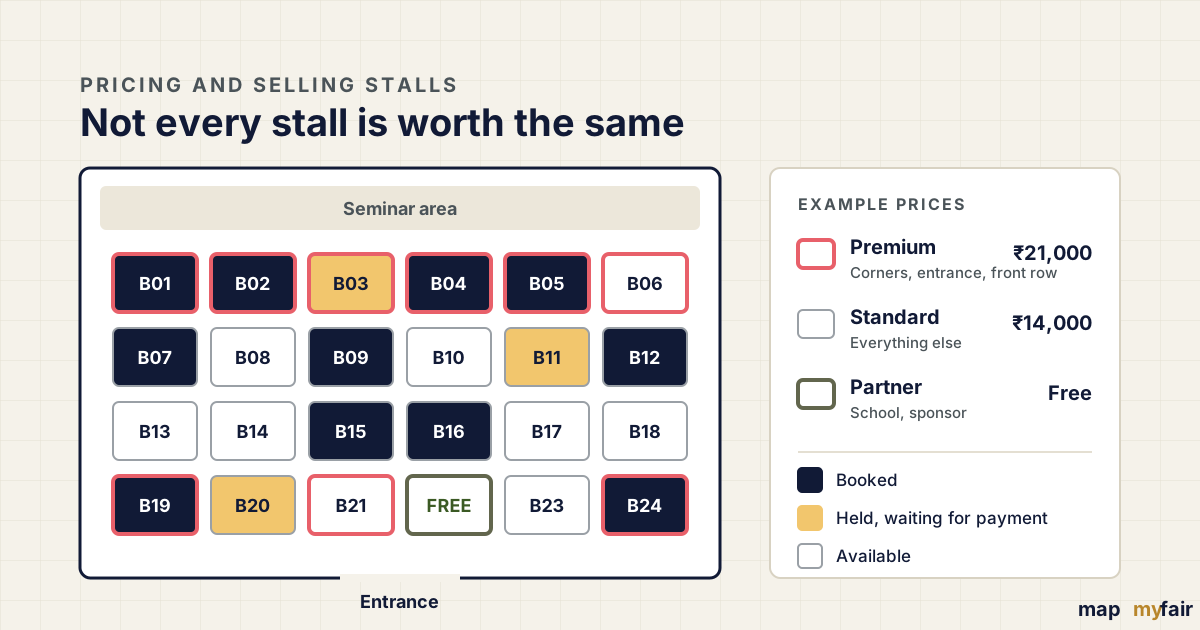
Walk into any fair and watch where the students go. They drift towards the entrance, the corners where two aisles meet, and the row facing the seminar area. The stall at the back, behind a pillar, gets a fraction of the footfall. Pricing them all the same either leaves money on the table for the good stalls or makes the bad ones impossible to sell.
So most organizers settle on two or three categories. The entrance, the corners and the front row become Premium, priced maybe 40 to 60 percent above the rest. Everything else is Standard, at your break-even plus a margin. And a handful of stalls stay free for partners: the school that sent you its students, a sponsor, the local education office.
Resist the urge to invent six categories. Every extra one is another conversation about why stall B14 costs more than B15.
Write down exactly what a stall includes
A table, two chairs, a power point, a name board on the front. Maybe a backdrop, maybe Wi-Fi. Whatever it is, put it on the booking page and in the agreement, in plain words. "Standard stall: one table, two chairs, one power point" saves you from the exhibitor who arrives expecting a TV screen and three chairs.
Say whether your prices include GST, too. Institutions' accounts teams will ask, and the invoice has to match what they were quoted. If you're not sure how GST applies to your fair, a short call with your CA before you publish prices is cheaper than reissuing forty invoices.
Sell from a map, not from memory
That corner-stall argument at the top only happens when stalls are promised before they're placed. The cure is a floor plan that shows, at any moment, which stalls are free, which are held and which are booked, and lets the institution pick its own. Nobody can be promised a stall that's already gone, because they can see it's gone.
It also sells stalls faster. An admissions head who can see that only three Premium stalls are left makes up their mind a lot quicker than one who's been told "we'll see what we can do".
Hold a stall, but not forever
Between "we'd like that stall" and "the money's in your account" there's always a gap. Universities need internal approval, a purchase order, a cheque signed by someone who's travelling. If you lock the stall for the whole gap, you'll end up with stalls held for weeks by people who never pay.
Two ways work well together. For institutions ready to pay now, hold the stall for a day or so while they pay and send the proof; if nothing arrives, the stall goes back on sale by itself. For trusted institutions that need time, approve the booking yourself and give them a firm due date before the fair. Either way, the rule is the same: a stall isn't sold until it's paid for.
Deposits, deadlines and cancellations
Decide, in writing, what happens when an institution cancels. Full refund until a certain date, a part refund after that, nothing in the last week, or whatever suits your costs. Put it in the agreement they sign. You'll rarely need it, but on the one occasion you do, you'll be glad it's there instead of on a WhatsApp thread.
An early-booking price with a clear end date helps too. It gives the slow-moving institutions a reason to move, and it gives you money in hand while you're still paying advances to the hall.
Pricing is one part of the bigger job. For the rest, from the venue to the week after, see our guide on how to organise an education fair.
Frequently asked questions
How much should an education fair stall cost?
There's no standard rate; it depends on your city, venue and audience. Work it out from your costs: add up everything the fair costs, divide by the number of stalls you expect to sell, and that's your break-even price. Price Standard stalls a little above it and Premium stalls 40 to 60 percent higher.
Should corner stalls cost more?
Yes. Corners, the stalls by the entrance and the front row get noticeably more students walking past, and institutions know it. Charging more for them is fair, and it keeps your Standard stalls affordable.
How long should I hold a stall for an institution that hasn't paid?
For someone paying now, a day or so is enough to pay and send the proof; after that the stall should go back on sale. For institutions that need longer, approve the booking yourself and set a firm payment date before the fair.
Do stall prices include GST?
That's your decision, but say it clearly on the booking page and in the agreement, because the invoice has to match what institutions were quoted. Check with your CA how GST applies to your fair before you publish prices.
Read next
- How to Organise an Education Fair: A Practical Guide for OrganizersPicking the date and hall, inviting institutions, pricing stalls, handling bookings and payments, and bringing students in: an education fair, step by step.
- Education Fair Checklist: From 12 Weeks Out to the Week AfterA week-by-week checklist for education fair organizers: the hall, bookings, paperwork, students, payments, the day itself and the follow-up. Print it and tick it off.