How to Invite Universities to Exhibit at Your Education Fair
By mapmyfair team · · 5 min read
You've booked the hall, fixed the dates and drawn up a list of three hundred universities. You send the same email to all of them on a Monday morning. By Friday you have four replies. One is an out-of-office, one asks to be removed from your list, and two say they'd like more details, which were in the email.
Inviting universities to exhibit is where most new fairs struggle, and it's rarely because the fair isn't worth attending. It's because the invitation reached the wrong person, at the wrong time, without the three facts they need to say yes. All three are fixable.
Write to a person, not to info@
A general inbox is where invitations go to wait. The person who decides whether their university comes to your fair is usually in admissions, outreach or marketing. At larger universities there's often someone whose whole job is recruitment events: an outreach manager, a regional head for your state, or, for universities abroad, an India representative or the team that plans the international recruitment calendar.
Finding them takes an afternoon, not a database. University websites list their admissions and international offices. LinkedIn shows who has "outreach" or "recruitment" in their title. Brochures from other fairs, which are often public, show which institutions exhibit in your region. And if you've run a fair before, last year's exhibitors are the best list you'll ever have.
Fifty invitations to the right people will do more than three hundred to inboxes nobody reads.
Write early enough to make their calendar
Universities plan their recruitment travel well ahead. A team that visits several Indian cities in a season usually fixes its route months before, and once the travel is booked, adding your fair means a fresh approval. Indian private universities can often decide faster, but their event budget may already be spoken for.
So the first invitation should go out three to four months before the fair, and earlier if you're inviting institutions from abroad. If that sounds early, it's because it is, compared with the week you'd like to be sending it. Our education fair checklist puts this in the twelve weeks before the fair, alongside everything else.
Answer their three questions in the first email
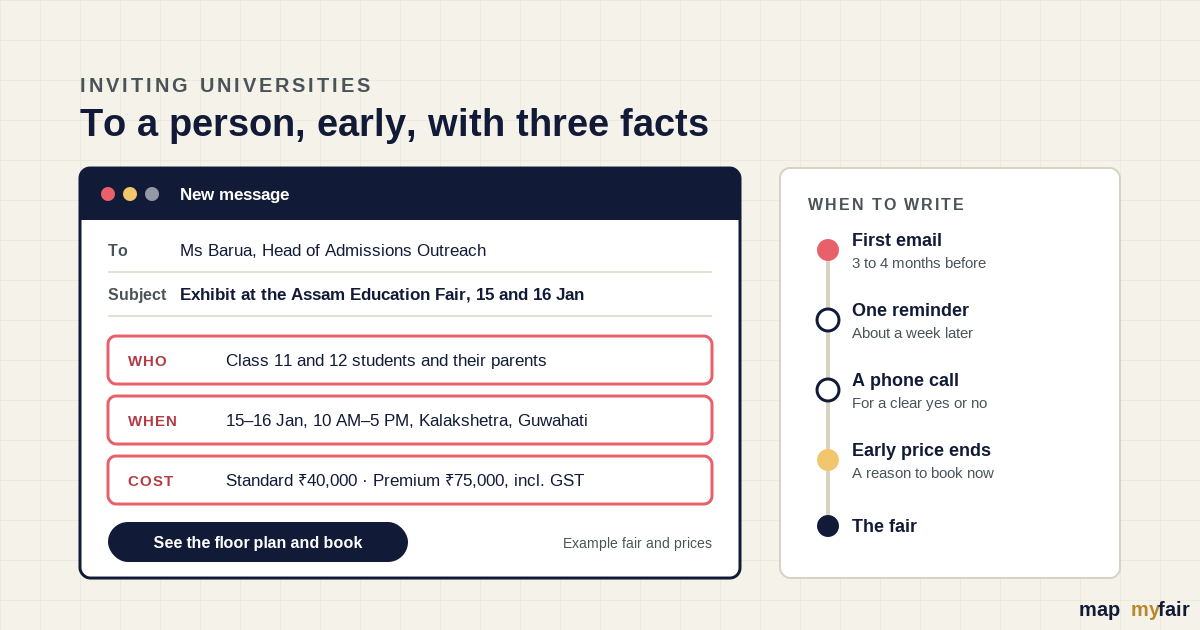
Every admissions head reading your email is asking the same things: who will we meet, when and where is it, and what will it cost us? If any of the three is missing, the email goes into the "later" pile. Put all three near the top:
- Who the students are: their class or level, the courses they're looking at, and the area they'll come from.
- The dates, the opening hours, and the venue with its address.
- The stall price, whether it includes GST, and what a stall comes with.
Be honest about numbers. If this is your first fair, don't promise five thousand visitors. Say what you're doing to bring students in, such as the schools you're working with and where you'll advertise. Admissions teams talk to each other, and a fair that over-promised once rarely gets a second chance.
Then give them one link where they can see the floor plan, pick a stall and book it. Every "please share the details" reply you avoid is a day saved. Here's the shape of an invitation that works. The fair and the prices are only an example.
Subject: Exhibit at the Assam Education Fair, Guwahati, 15 and 16 January
Dear Ms Barua,
We're holding the Assam Education Fair at Srimanta Sankaradeva Kalakshetra in Guwahati on 15 and 16 January, 10 AM to 5 PM. We're expecting Class 11 and 12 students and their parents from Guwahati and the nearby districts, and we're inviting about forty universities.
Standard stalls are ₹40,000 and Premium stalls, by the entrance and on the corners, are ₹75,000, both including GST. Each comes with a table, two chairs, a power point and a name board. You can see the floor plan and book a stall here: [your booking link]
If January doesn't suit your team, I'd be glad to tell you about our next fair.
Regards, …
Notice what isn't there: a paragraph about how important education is, or a PDF brochure they have to download before they learn the price.
Follow up once, then pick up the phone
One reminder about a week later, short and with the link again, is reasonable. A third and fourth email aren't. After that, call. In India a lot of admissions work happens over the phone and on WhatsApp, and a two-minute call often gets you a straight answer ("we're doing Kolkata that week, try us for the March fair") that no email would have.
Keep a simple note of every answer, including the no's. "Not this year, budget closes in March" is valuable: it tells you exactly when to write next year.
Give them a reason to book now
Universities that intend to come often decide late, which leaves you guessing about the hall until the last fortnight. Two things move them sooner. An early-booking price with a real end date gives the slow ones a reason to act. And seeing the floor plan fill up does the rest: an admissions head who can see that only three Premium stalls are left, and which universities have already booked, decides quickly.
That second one only works if the floor plan they see is the real one. If you're still holding stalls in a spreadsheet and confirming by email, every booking is a conversation. If they can pick a stall, book it and pay from the link in your email, it's a few minutes. Our guide to pricing and selling stalls has more on holding stalls and early-booking prices.
After the fair, the invitation for next year has already started
The universities that exhibited this year are next year's easiest yes. Write to them within a week of the fair with something useful: how many students came, which courses they asked about, and the dates of your next fair if you know them. The ones who couldn't come this time go on the same list, with the note about when to try again.
Do this for two or three fairs and the invitation stops being a cold email. It becomes a message to people who know you, which is the only kind that reliably gets a reply. For the rest of the job, from the venue to the week after, see how to organise an education fair.
Frequently asked questions
How early should I invite universities to an education fair?
Three to four months before the fair, and earlier for universities abroad. Recruitment teams fix their travel well ahead, and once it's booked, adding your fair needs a fresh approval.
Who at a university should I send the invitation to?
The person who decides on recruitment events: usually in admissions, outreach or marketing, or the international office for universities abroad. A named person replies far more often than a general info@ inbox.
What should an education fair invitation include?
Who the students are, the dates, hours and venue, and the stall price with what a stall includes and whether GST is included. Add one link where they can see the floor plan and book.
How many times should I follow up?
One email reminder about a week later, then a phone call. More emails rarely help; a short call usually gets a clear yes, no or 'try us next time'.
Read next
Fill every booth. Shrink the paperwork.
Create the event. Map the booths. Sell the space. Get paid.